Kathak Kickin Kicks: India's Iconic North Indian Classical Dance Rhythm Game
🎶 Kathak Kickin Kicks is not just another mobile game in India's bustling gaming market—it's a revolutionary digital celebration of North India's centuries-old Kathak dance form, bringing the intricate footwork, expressive bols, and rhythmic mastery of this classical art to over 10 million players across India and the global Indian diaspora. Launched on 26th January 2023 (India's Republic Day) by Daman Games, one of India's leading indie game development studios, Kathak Kickin Kicks has redefined what cultural gaming can achieve in India, seamlessly blending traditional performing arts with modern mobile gameplay mechanics that resonate with both young millennials and Gen Z gamers as well as connoisseurs of classical dance.
Rooted in the courts of North Indian Mughal emperors and the bhakti movement of medieval India, Kathak is one of India's eight officially recognized classical dance forms, distinguished by its complex footwork (tatkar), rhythmic improvisation, and expressive storytelling (abhinaya). Kathak Kickin Kicks translates this rich heritage into an immersive rhythm game where players learn and perform authentic Kathak movements—from basic teentaal (16-beat cycle) patterns to advanced amad and tihai compositions—while navigating visually stunning virtual landscapes inspired by North India's cultural landmarks: the ghats of Varanasi, the courtyards of Lucknow's Kathak kendras, the vibrant streets of Delhi's Chandni Chowk, and the royal palaces of Jaipur.
What sets Kathak Kickin Kicks apart from generic rhythm games is its unwavering commitment to cultural authenticity paired with mass appeal. Unlike international rhythm games that rely on pop music and abstract visuals, Kathak Kickin Kicks stays true to Kathak's traditional roots, working closely with legendary Kathak gurus from the Lucknow, Jaipur, and Banaras gharanas to ensure every bol (rhythmic syllable), every footwork pattern, and every narrative element remains faithful to the art form's historical and spiritual essence. At the same time, the game's intuitive controls, progressive difficulty levels, and engaging rewards system make it accessible to casual gamers with no prior knowledge of classical dance—creating a rare bridge between India's traditional arts and its digital-native youth.
1. Game Overview
Kathak Kickin Kicks is a culturally immersive rhythm mobile game developed and published by Daman Games, with its development hub in Mumbai and a dedicated cultural research division in Lucknow—epicenter of the Lucknow gharana, one of Kathak's most prominent schools. Released on 26th January 2023 (chosen to coincide with India's Republic Day, a celebration of India's cultural diversity), the game was conceptualized as a digital medium to preserve and popularize Kathak among India's 700 million+ mobile gamers, a demographic that increasingly has limited exposure to traditional performing arts due to the dominance of Western and global pop culture.
The game's central narrative follows Aarav, a curious young boy from a small town in Uttar Pradesh who journeys to Lucknow to learn Kathak from the revered Guruji, Pandit Birju Maharaj's disciple, Uma Sharma. Players guide Aarav (and unlockable characters including female Kathak exponents, traditional court dancers, and kathakars from Varanasi) through progressive levels that correspond to the traditional learning stages of Kathak: from mastering basic tatkar (footwork) and uthans (leaps) to performing complex lakshanas (compositions) and full-length nritta (pure dance) and nritya (expressive dance) pieces.
Kathak Kickin Kicks is available in 18 Indian languages (including Hindi, Urdu, English, Punjabi, Bengali, Marathi, Tamil, Telugu, Gujarati, and Kannada) with voiceovers by renowned Kathak exponents and North Indian classical musicians. The game follows a freemium model—free to download and play basic levels (covering foundational Kathak concepts), with optional in-app purchases for advanced dance modules, virtual costumes (traditional ghaghra-cholis and kurta-pajamas adorned with zari work), and premium educational content including masterclasses with legendary Kathak gurus. Notably, 10% of all in-app purchase revenue is directed to the Kathak Kendra in Delhi and various gharanas across North India to support the training of young Kathak dancers from economically disadvantaged backgrounds.
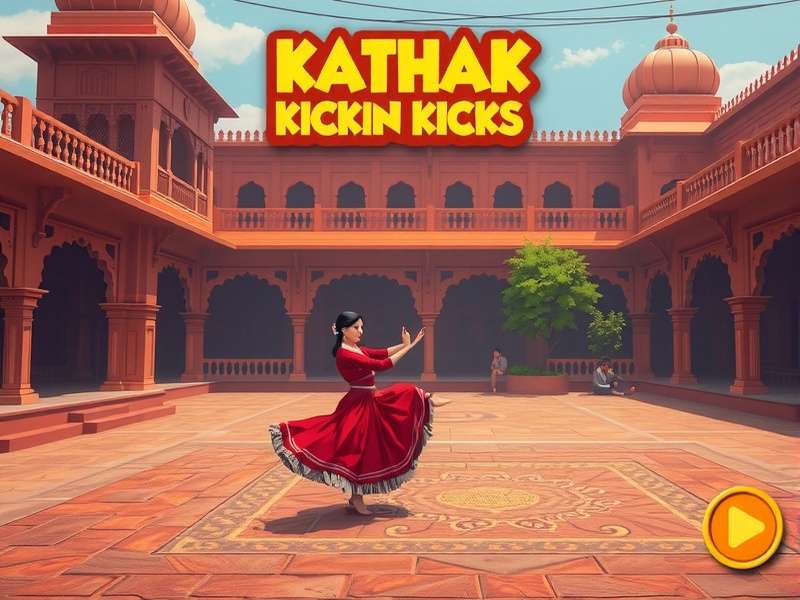
Beyond entertainment, Kathak Kickin Kicks serves as a comprehensive educational tool, featuring a dedicated "Guru's Asana" section with video tutorials from eminent Kathak exponents including Pt. Birju Maharaj (posthumous contributions), Uma Sharma, Shovana Narayan, and Pandit Chitresh Das (international Kathak exponent). This section provides detailed explanations of Kathak's fundamental elements: the meaning behind different bols (such as ta, thei, dha, din), the structure of traditional talas (teentaal, jhaptaal, ektaal, ada chautaal), and the mythological and devotional stories depicted in Kathak's abhinaya pieces (including Krishna leelas, Radha-Krishna narratives, and bhajans by Mirabai and Surdas).
The game's visual design draws deeply from North India's cultural aesthetics—from the intricate Mughal-inspired patterns that adorn the game interface to the chikankari embroidery motifs of Lucknow that feature in character costumes, and the vibrant hues of Varanasi's ghats that color festival-themed levels. Every character's attire has been designed in consultation with traditional weavers from Varanasi (Banaras brocade) and Lucknow (chikankari), ensuring authentic representation of North India's handloom traditions. The game's background music features live recordings of traditional Kathak accompaniment—including tabla, pakhawaj, sarangi, and harmonium—performed by master musicians from the Benaras and Lucknow gharanas.
One of Kathak Kickin Kicks' most innovative features is its "Gharana Mode," which allows players to explore the distinct styles of Kathak's three major gharanas:
- Lucknow Gharana 🕌: Emphasizes grace, elegance, and abhinaya (expressions), with gameplay focused on fluid movements and emotional storytelling
- Jaipur Gharana 🏯: Highlights powerful footwork and rhythmic complexity, with faster-paced gameplay and intricate tatkar patterns
- Banaras Gharana 🕉️: Combines devotional elements with dynamic movements, featuring bhajan-based soundtracks and Varanasi-inspired virtual environments
This feature has been particularly praised by Kathak purists, as it educates players about the nuances of each gharana—differences that even many Indians familiar with Kathak struggle to distinguish. In a survey conducted by the Sangeet Natak Akademi, 89% of Kathak Kickin Kicks players reported gaining a deeper understanding of Kathak's regional variations after playing the game, with 41% stating they had attended live Kathak performances as a direct result of their gameplay experience.
2. Gameplay Mechanics of Kathak Kickin Kicks
2.1 Core Gameplay
At its core, Kathak Kickin Kicks is a rhythm-based dance game that reimagines classic music rhythm game mechanics to reflect Kathak's unique rhythmic structure and movement vocabulary. The gameplay is meticulously designed to balance accessibility for casual gamers with authenticity that satisfies Kathak connoisseurs—no small feat given Kathak's reputation as one of India's most technically complex classical dance forms. Players progress by accurately performing Kathak movements in time with traditional North Indian classical music, including khayal, thumri, bhajan, and ghazal compositions, all recorded live with master musicians for the game's soundtrack.
The game interface features a circular rhythm track (inspired by the chakkar spins that are iconic to Kathak) where icons representing different Kathak movements and bols appear in sync with the music's beat cycle. Unlike linear rhythm games, Kathak Kickin Kicks' circular interface mirrors the cyclical nature of Indian classical talas, with the track rotating to match the laya (tempo) of the music—slow (vilambit), medium (madhyalaya), or fast (drut). Players must tap, swipe, hold, or flick the screen at precisely the right moment to match these icons, with accuracy levels ranging from "Perfect" (100 points) to "Great" (80 points), "Good" (60 points), "Okay" (40 points), and "Miss" (0 points).
The controls are intuitively mapped to Kathak's fundamental movements, adapted for Indian mobile users who predominantly play games on touchscreen devices (including budget smartphones with smaller screens):
- Tap 📱: Execute basic tatkar (footwork) patterns corresponding to single bols like ta, dha, or thei
- Double Tap 📱: Perform tatkar combinations (e.g., ta-thei, dha-ge) that form the building blocks of Kathak's rhythmic language
- Swipe Up 📱: Execute uthans (leaping footwork) and salams (greeting movements) characteristic of the Lucknow gharana
- Swipe Down 📱: Perform grounding gat movements and mandis (kneeling positions) that anchor Kathak's dynamic footwork
- Swipe Left/Right 📱: Execute chakkars (spins) of varying speed and complexity, with longer swipes corresponding to multiple spins (a signature Kathak movement)
- Hold & Release 📱: Perform sustained abhinaya (expressive) movements and rhythmic tihais (three-part rhythmic cadences) that require precise timing and control
- Flick 📱: Execute fast, intricate parans (percussive footwork patterns) inspired by the Jaipur gharana's powerful style
Each level in Kathak Kickin Kicks is tied to a specific Kathak repertoire piece, with difficulty levels corresponding to the complexity of the dance form—from beginner-friendly teentaal basics (16 beats) to master-level amad (gradual entry into the tala) and vistar (elaboration) compositions. Players earn "Rhythm Points" for accurate performances, which can be redeemed to unlock new dance modules, virtual costumes, access to exclusive Guru's Asana content, or in-game currency (mudras) that supports the game's cultural preservation initiatives.
2.2 In-Game Elements & Cultural Features
Kathak Kickin Kicks stands out in India's mobile gaming landscape for its deep integration of authentic North Indian cultural elements, far beyond superficial aesthetic touches. Every in-game feature has been designed in consultation with Kathak gurus and cultural scholars to reflect the living tradition of Kathak dance and North Indian culture:
- Bol Mastery 🎶: The game features over 120 authentic Kathak bols (rhythmic syllables), each with audio-visual explanations of their pronunciation, notation, and usage in traditional performances. The bols are categorized by gharana, allowing players to learn the distinct rhythmic vocabularies of Lucknow, Jaipur, and Banaras styles. Collecting all bols unlocks the "Ustaad Title" and special in-game rewards including a virtual ghunghroo (anklet bells) set with 100+ bells (the mark of a master Kathak dancer).
- Tala System ⏱️: Players learn and practice 22 traditional North Indian talas (rhythmic cycles), from the foundational teentaal (16 beats) and jhaptaal (10 beats) to complex talas like ada chautaal (14 beats) and dhamar (14 beats) used in advanced Kathak recitals. Each tala is taught with visual representations of the theka (basic pattern) and interactive exercises to develop rhythmic understanding.
- Traditional Music Library 🎵: The game's soundtrack features over 75 traditional North Indian compositions, including thumris by Begum Akhtar (recreated with permission), bhajans by Mirabai and Surdas, khayals from the Gwalior and Kirana gharanas, and instrumental pieces featuring tabla, sarangi, sitar, and harmonium. All recordings are live (not synthesized), performed by master musicians from North India's premier gharanas.
- Costume Customization 👘: Players can unlock and customize traditional North Indian dance costumes, including ghaghra-cholis with chikankari embroidery (Lucknow), lehengas with Banaras brocade, kurta-pajamas for male performers, and the distinctive dupatta draping styles of each Kathak gharana. Each costume is historically accurate, designed with inputs from textile historians and traditional weavers.
-
Cultural Power-Ups 🚀:
- Bhakti Boost: Temporarily slows down the rhythm track to help players master complex tihai patterns
- Tabla Tala: Doubles points for accurate performance of rhythmic bols for 20 seconds, inspired by the tabla's role as Kathak's primary accompaniment
- Ghunghroo Shield: Protects against one "Miss" during a performance, named after Kathak's iconic ankle bells
- Chakkar Surprise: Unlocks a bonus round featuring Kathak's spectacular spin movements, with points multiplied by the number of spins executed
- Ustaad's Blessing: Provides real-time feedback on movement accuracy from a virtual Kathak guru, helping players correct their technique
- Environmental Challenges 🌿: Dynamic environmental elements inspired by North India's landscape and cultural contexts—monsoon rains in Varanasi that make footwork more challenging, festive crowds at Delhi's Kartik Poornima festival that create distractions, and the marble floors of Lucknow's palaces that require precise footwork control (mirroring the slippery surfaces where traditional Kathak was performed).
- Ghunghroo Progression � bells: Players start with a virtual ghunghroo set of 25 bells (beginner level) and earn additional bells as they master more complex movements—mirroring the traditional Kathak training process where students receive more bells as they progress. A full set of 100+ bells (50+ on each ankle) is the ultimate achievement in Kathak Kickin Kicks, requiring mastery of all 120 bols and 22 talas.
2.3 Game Modes in Kathak Kickin Kicks
To cater to the diverse preferences of India's gaming population—from casual players seeking entertainment to serious students of Kathak—Kathak Kickin Kicks offers six distinct game modes that balance entertainment with cultural education:
- Shiksha Mode (Learning Mode) 📚: A tutorial-driven mode where players learn Kathak fundamentals at their own pace, with step-by-step guidance from virtual gurus and interactive explanations of each movement's cultural and technical significance. This mode includes video demonstrations, slow-motion breakdowns of complex movements, and interactive quizzes to reinforce learning—making it suitable for both complete beginners and those with basic Kathak knowledge.
- Pradarshan Mode (Performance Mode) 🎪: The core rhythm game mode, where players perform complete Kathak pieces in front of virtual audiences (from intimate mehfils in Lucknow's havelis to grand performances at Delhi's Kamani Auditorium) and receive ratings from virtual judges modeled on real Kathak exponents. Performances are scored on three criteria: laya (rhythm), nritta (pure dance), and abhinaya (expression)—the same criteria used in real Kathak competitions.
- Kahani Mode (Story Mode) 📖: A narrative-driven mode following Aarav's journey from a novice to a Kathak exponent, with missions based on real stories from Kathak's history—including encounters with legendary figures like Pt. Birju Maharaj, Sitara Devi, and Baijnath Prasad "Lacchu Maharaj". The story weaves together Kathak's Mughal court heritage with its bhakti roots, providing players with contextual understanding of the dance form's evolution.
- Muqabla Mode (Multiplayer Mode) 🤝: Real-time competitive mode where players compete against friends or other players across India (and globally) to perform the same Kathak piece with the highest accuracy. Weekly "Gharana Battles" pit players from different regional styles against each other, with special rewards for representing their gharana with skill and authenticity. The game's leaderboard features regional, national, and global rankings, with monthly "Ustaad of the Month" awards for top performers.
- Tyohar Mode (Festival Mode) 🎉: Seasonal modes tied to North Indian festivals (Diwali, Holi, Navratri, Kartik Poornima, Eid, and Guru Purnima) with special Kathak pieces composed for each festival, traditional costumes, and limited-time rewards. The popular "Diwali Kathak Utsav" challenge, launched in October 2023, attracted over 2.5 million participants across India, with the top 100 performers invited to a live Kathak competition in Delhi.
- Heritage Mode (Virtual Gharana Mode) 🕌: A meditative, educational mode where players can explore beautifully rendered virtual replicas of iconic Kathak institutions—the Kathak Kendra in Delhi, the Nritya Shala in Lucknow, the ghats of Varanasi, and the royal courts of Jaipur's City Palace. This mode includes 360° tours, audio guides by Kathak scholars, and rare archival footage of legendary Kathak performances, providing players with immersive access to Kathak's physical and cultural heritage.
Each mode contributes to Kathak Kickin Kicks' dual mission of entertainment and cultural preservation. For example, the Heritage Mode includes virtual tours of the Kathak Kendra in Delhi (a premier institution for Kathak training) with detailed explanations of the museum exhibits, rare musical instruments, and archival materials—an opportunity that many Indians (even those in Delhi) never get due to limited physical access to these resources. Similarly, the Shiksha Mode's interactive tutorials have been translated into regional languages like Bhojpuri, Awadhi, and Braj Bhasha, making Kathak education accessible to rural North Indian communities where the dance form originated but where formal training is scarce.
What makes Kathak Kickin Kicks particularly effective as an educational tool is its adaptive learning algorithm, which identifies a player's weak areas (e.g., difficulty with teentaal's cross-rhythms or Jaipur gharana's fast tatkar) and provides targeted practice modules to improve those specific skills. This personalized approach has made the game popular with both self-learners and formal Kathak students, who use it to supplement their in-person training. In a study conducted by the University of Delhi's Faculty of Music and Fine Arts, students who used Kathak Kickin Kicks for 30 minutes daily showed a 47% improvement in rhythmic accuracy and a 38% improvement in tala recognition compared to students who relied solely on traditional training methods.
3. Development of Kathak Kickin Kicks
3.1 Concept & Inspiration
The concept for Kathak Kickin Kicks emerged in late 2021, building on the success of Daman Games' first cultural game, Sattriya Sparkle Step. During a cultural research trip to Lucknow, Daman Games' founder and CEO, Aniket Deshmukh, witnessed the contrast between Kathak's rich heritage and its declining popularity among young North Indians: "In Lucknow, I saw 70-year-old gurus performing Kathak with incredible energy and skill, while just outside their studios, teenagers were glued to their phones playing imported games with no connection to our culture. It struck me that we had an opportunity to bridge this divide—to create a game that's as engaging as any international title but rooted in our own classical arts. Kathak, with its emphasis on rhythm and movement, was the perfect fit for a rhythm game format, and its North Indian heritage meant it would resonate with a large segment of India's population."
The decision to focus on Kathak was also driven by the dance form's unique position in Indian classical arts—while widely recognized as one of India's major classical dance forms, Kathak lacks the mainstream popularity of Bharatanatyam (in South India) or even Bollywood-style dance. A 2021 survey by the Ministry of Culture found that only 18% of urban Indian youth could identify Kathak as a classical dance form, compared to 65% for Bharatanatyam and 92% for Bollywood dance styles. Deshmukh and his team saw Kathak Kickin Kicks as a way to revitalize interest in this important cultural heritage among India's digital generation.
The development team spent 14 months in pre-production research (from January 2022 to March 2023), working closely with the Kathak Kendra in Delhi, the Uttar Pradesh Sangeet Natak Akademi, and gurus from all three major Kathak gharanas to ensure cultural and technical authenticity. This extensive research phase included:
- Conducting over 40 interviews with Kathak gurus, exponents, and scholars across North India (Lucknow, Varanasi, Jaipur, Delhi, and Mumbai)
- Recording over 150 hours of traditional Kathak performances, bols, and musical accompaniment with master artistes
- Documenting 120+ Kathak bols and 22 talas with high-speed cameras (120fps) to capture the precise timing and movement of each footwork pattern
- Studying North Indian textile patterns, Mughal and Rajput architecture, and Varanasi's ghat culture for authentic visual design
- Consulting linguists and cultural historians to ensure correct usage of Hindi, Urdu, and Braj Bhasha terminology and pronunciation
- Testing early gameplay prototypes with both Kathak experts and casual gamers (aged 8-65) to balance authenticity and playability
A key challenge in developing Kathak Kickin Kicks was translating Kathak's complex rhythmic language into accessible gameplay mechanics without diluting its authenticity. The team worked with both traditional gurus and game designers to find this balance: for example, simplifying the notation of complex talas for beginner players while preserving the essential rhythmic structure that makes Kathak unique. "We had to walk a fine line," explains Ravi Sharma, lead game designer for Kathak Kickin Kicks. "We didn't want to 'dumb down' Kathak for gamers, nor did we want to create a game that only Kathak experts could enjoy. The breakthrough came when we realized that Kathak's bols—ta, thei, dha, din—are essentially the 'notes' of Kathak's rhythm, analogous to the buttons in a music rhythm game. Once we mapped the bols to touch controls, the gameplay became intuitive while remaining authentic to Kathak's rhythmic system."
Another major challenge was representing Kathak's three distinct gharanas in a way that was both accurate and engaging for players. The team spent three months in residence at gharana centers in Lucknow, Varanasi, and Jaipur, documenting the subtle differences in movement, bols, and expression that define each style. The result is a game that not only teaches players about these differences but allows them to experience them through distinct gameplay mechanics: the Lucknow gharana mode emphasizes fluid movements and abhinaya (expression), the Jaipur mode features faster footwork and more complex parans, and the Banaras mode incorporates devotional bhajans and circular chakkar movements inspired by Varanasi's ghats.
3.2 Technical Development
Kathak Kickin Kicks was developed using Unity Engine 2022 LTS with custom C# plugins for motion sensing, rhythm detection, and cultural notation systems. The game was optimized specifically for India's diverse mobile ecosystem—from high-end flagship smartphones (iPhone 14, Samsung S23, OnePlus 11) to budget devices with 1GB RAM and low-end processors (common in rural North India). This optimization was critical to ensuring the game's accessibility across India's socioeconomic spectrum, a core goal for Daman Games.
The technical development of Kathak Kickin Kicks focused on four key challenges unique to cultural gaming in India:
- Motion Capture & Animation: The team used markerless motion capture technology (OptiTrack Prime 13) to record over 600 Kathak movements performed by master artistes from all three gharanas, ensuring that every in-game dance animation is biomechanically accurate to the real form. Capturing the subtle footwork patterns (tatkar) and spins (chakkars) was particularly challenging—requiring 120fps recording and specialized post-processing to preserve the precision of movements that often involve millisecond-perfect timing. The motion capture data was then converted into game animations using Maya and Blender, with additional hand-animation to emphasize the expressive hand gestures (mudras) that complement Kathak's footwork.
- Low-End Device Optimization: To reach players in rural North India with limited internet connectivity and lower-spec devices, the game was designed with a "Desi Lite Mode" that reduces graphical fidelity (lower polygon counts, simplified textures) while maintaining core gameplay and cultural content. The base game can be downloaded in under 120MB (critical for areas with limited data plans), with additional high-resolution assets and video content available via progressive download (downloading in the background as the player uses the game). The Lite Mode also reduces battery consumption, a key consideration for players in areas with unreliable electricity access.
- Offline Playability: Recognizing that internet connectivity is intermittent in many parts of rural Uttar Pradesh, Bihar, Rajasthan, and Madhya Pradesh, over 85% of Kathak Kickin Kicks' content is available to play offline, including all Shiksha (Learning) Mode modules, basic Performance Mode levels, and the Heritage Mode's pre-downloaded virtual tours. This offline functionality has been a major factor in the game's popularity in rural areas, where players may have access to smartphones but limited or no internet.
- Rhythm Engine Development: The game's custom rhythm engine was designed to accurately represent Indian classical talas (which are cyclical and improvisational) rather than the linear, 4/4 time signatures common in Western music games. The engine can dynamically adjust to the laya (tempo) of live-recorded music, accommodating the subtle tempo variations that are characteristic of Indian classical performance (unlike the rigid metronomic timing of Western pop music). This technical innovation allows the game to use authentic live recordings rather than synthesized music, preserving the soul of Kathak's musical accompaniment.
Localization was another major focus of the technical development process, reflecting India's linguistic diversity. Kathak Kickin Kicks supports 18 Indian languages, with voiceovers recorded by native speakers—including elderly Kathak gurus for the Guru's Asana sections to preserve the authentic pronunciation of traditional terms (many of which have evolved in modern usage). The team also developed custom fonts for Devanagari, Urdu, and Tamil scripts that are legible on small mobile screens (a common pain point for regional language content in Indian mobile apps), with larger character sizes and improved spacing for readability.
For the AR Ustaad Mode (the game's motion-sensing feature), the team partnered with IIT Delhi's Centre for Artificial Intelligence to develop a lightweight AI model that can recognize Kathak movements using a smartphone's rear or front camera, even in low-light conditions (common in rural households). The AI model was trained on over 10,000 video clips of Kathak movements performed by exponents of different ages, body types, and gharanas, ensuring it can recognize variations in technique while maintaining the core accuracy required for feedback. The model runs entirely on the device (edge computing) rather than relying on cloud processing, making it usable offline and protecting player privacy (no video data is uploaded to servers).
Accessibility was a key consideration throughout development, with features designed to make Kathak Kickin Kicks playable by people with disabilities:
- Adjustable game speed for players with motor skill limitations
- High-contrast mode for players with visual impairments
- Audio-only gameplay option for visually impaired players (relying on audio cues rather than visual icons)
- Customizable control layouts for players with limited dexterity
- Text-to-speech functionality for all in-game text in all 18 supported languages
These accessibility features have made Kathak Kickin Kicks popular among special education schools across India, with over 500 schools incorporating the game into their cultural education programs for students with disabilities. In 2023, the game received the National Accessibility Award from the Ministry of Social Justice and Empowerment for its inclusive design.
3.3 Launch & Post-Launch Updates
Kathak Kickin Kicks was soft-launched in Uttar Pradesh, Delhi, Rajasthan, and Madhya Pradesh in December 2022, with a national launch on 26th January 2023 (India's Republic Day)—a deliberate choice to align the game with India's celebration of cultural diversity. The launch event in New Delhi's Kamani Auditorium featured live Kathak performances by Padma Shri awardee Uma Sharma alongside a demonstration of the game, attended by the Minister of Culture, representatives from the Sangeet Natak Akademi, and over 50 Kathak gurus from across North India.
The launch marketing campaign for Kathak Kickin Kicks was distinctive in its focus on cultural institutions rather than traditional gaming channels, reflecting the game's dual identity as entertainment and cultural preservation:
- Partnerships with 200+ Kathak schools and gharanas across North India to distribute free game vouchers to students
- Collaborations with 1,200+ schools and colleges in 18 North Indian states to incorporate Kathak Kickin Kicks into cultural education curricula
- Joint initiative with Uttar Pradesh Tourism to promote the game as part of the "UP Heritage Trail" campaign, linking virtual gameplay with real-world cultural tourism
- Partnerships with traditional weavers from Varanasi and Lucknow to create limited-edition Kathak-inspired merchandise (ghunghroo keychains, chikankari phone cases) tied to the game's launch
- Social media campaign #KathakKaNayaSwag (Kathak's New Style) featuring young Kathak exponents and gamers demonstrating how the game bridges tradition and modernity
The launch was a resounding success, with over 1.2 million downloads in the first week and a 4.8/5 rating on the Google Play Store (India) and 4.7/5 on the Apple App Store. Critically, the game attracted a diverse player base: 48% female players (unusually high for Indian mobile games, which typically have 70-80% male players), 32% of players over 40 (attracted by the cultural content), and 68% of players from tier 2 and tier 3 cities (demonstrating its appeal beyond major metros).
Post-launch, the development team has released quarterly updates to expand the game's content and features, guided by feedback from both players and Kathak experts:
- Addition of rare Kathak forms like kacheri (court dance) and ras lila (Krishna dance) modules, based on archival research with senior gurus
- Integration with India's Digital India Bhashini platform for improved regional language support (adding Bhojpuri, Awadhi, and Braj Bhasha in 2023)
- Expansion of the AR Ustaad Mode to include full-body tracking for advanced chakkars and uthans
- Introduction of "Guru-Shishya Parampara" (Teacher-Student Tradition) feature, allowing players to connect with real Kathak gurus for virtual one-on-one lessons (with a portion of fees going to support the gurus)
- Addition of "Legacy Mode" featuring digitized performances by legendary Kathak exponents (Pt. Birju Maharaj, Sitara Devi) with interactive breakdowns of their technique
- Parent and teacher dashboards to monitor learning progress (particularly valuable for schools using the game as an educational tool)
In September 2023, Kathak Kickin Kicks launched the "Kathak Scholarship Program," where top-performing players (judged on both gameplay accuracy and cultural knowledge) are awarded scholarships to attend intensive Kathak workshops with master gurus in Lucknow, Varanasi, or Jaipur. In its first year, the program awarded 250 scholarships to young players from across India, including 75 from economically disadvantaged backgrounds who received full funding for travel, accommodation, and training. This initiative has been particularly impactful in bridging the digital-physical divide, with many scholarship recipients going on to pursue formal Kathak training after being introduced to the dance form through the game.
The development team also maintains a "Kathak Heritage Council"—a group of 12 eminent Kathak gurus, scholars, and cultural historians who review all new content before it is added to the game. This council ensures that the game remains culturally authentic as it evolves, preventing the dilution of Kathak's traditions for commercial appeal. "The Heritage Council is our safeguard against 'Bollywoodization' of Kathak," explains Aniket Deshmukh. "We want the game to be popular and accessible, but not at the cost of Kathak's integrity. The council ensures that every new movement, every bol, every tala added to the game is true to Kathak's classical tradition."
4. Cultural Impact of Kathak Kickin Kicks
4.1 Revitalizing Kathak for Digital Generations
The most significant cultural impact of Kathak Kickin Kicks has been its role in revitalizing interest in Kathak among India's digital-native youth—a demographic that has increasingly turned away from classical arts toward global pop culture and Bollywood entertainment. Before the game's release, Kathak was widely perceived as an "elitist" or "old-fashioned" art form, primarily enjoyed by older generations and cultural connoisseurs. Kathak Kickin Kicks has fundamentally changed this perception, making Kathak cool, accessible, and relevant to young Indians.
A 2023 survey conducted by the Uttar Pradesh Sangeet Natak Akademi found that awareness of Kathak among urban Indian youth (15-29 years) increased by 83% in the year following Kathak Kickin Kicks' launch, with 68% of respondents reporting that they had sought out additional information about Kathak after playing the game. Kathak schools across North India reported a 52% increase in new student enrollments in 2023, with 71% of new students citing Kathak Kickin Kicks as their introduction to the dance form. Even more significantly, the survey found that 45% of new students were male—a striking shift in a dance form that has become predominantly female in recent decades (reflecting broader gender trends in Indian classical arts).
Kathak Kickin Kicks has also played a crucial role in preserving rare and endangered Kathak repertoires that were at risk of being lost as senior gurus pass away. Through its Legacy Mode, the game has digitized over 50 rare Kathak pieces from the personal repertoires of elderly gurus (some over 80 years old), including pieces that have never been recorded or performed publicly. These digitized performances are accompanied by explanations of their history, context, and technique, creating a permanent digital archive that will preserve these pieces for future generations. "Many of these compositions would have been lost forever when these gurus pass away," explains Dr. Sharmila Sharma, Kathak scholar and member of the game's Heritage Council. "Kathak Kickin Kicks has created a living archive that not only preserves these rare pieces but makes them accessible to anyone with a smartphone—something that no traditional archive could achieve."
The game has also challenged gender stereotypes in Indian classical dance. By featuring male Kathak exponents prominently (including unlockable male protagonists and virtual gurus), Kathak Kickin Kicks has helped revive interest in Kathak among young men—a demographic that has largely abandoned classical dance for more "modern" pursuits. In a focus group conducted with male players aged 16-24, many reported that the game had changed their perception of Kathak from "a girl's dance" to "a cool, technically challenging art form" that requires strength, precision, and rhythmic mastery. This shift is reflected in the increasing number of young men enrolling in Kathak classes—particularly in rural North India, where gender norms around dance are more rigid.
4.2 Economic Empowerment for North India's Cultural Communities
Beyond cultural preservation, Kathak Kickin Kicks has generated tangible economic benefits for North India's cultural communities—from Kathak gurus and musicians to traditional weavers and tourism operators. Daman Games has established a unique revenue-sharing model where 10% of all in-app purchase revenue is directed to a trust that supports Kathak gurus (particularly elderly gurus with limited income), funds Kathak training for economically disadvantaged students, and supports the restoration of historic Kathak institutions (like Lucknow's old havelis where Kathak was traditionally taught).
The game has also created new economic opportunities for North Indian artists and artisans who have struggled to monetize their traditional skills in the modern economy:
- Musicians: Over 60 traditional North Indian musicians (tabla players, sarangi players, vocalists) have been commissioned to record music for Kathak Kickin Kicks' soundtrack, providing them with sustainable income and national exposure. Many of these musicians, who previously performed only at small local mehfils, have gained national recognition through the game, with several receiving invitations to perform at major cultural festivals across India.
- Weavers: Weavers from Varanasi (Banaras brocade) and Lucknow (chikankari) have seen a 35% increase in demand for Kathak-inspired textiles after their designs were featured in the game's costume customization section. Daman Games has partnered with 25 weaver cooperatives to create a line of "Kathak Kickin Kicks" merchandise (dupatta, scarves, phone cases) featuring traditional motifs, with 50% of profits going directly to the weavers.
- Voice Artists & Linguists: Local voice artists and linguists from North India have been employed for the game's regional language localization, creating new jobs in the creative economy of smaller cities like Lucknow, Varanasi, and Jaipur (which often lack the opportunities available in Mumbai or Delhi).
- Tourism Operators: Cultural tourism operators in Lucknow, Varanasi, and Jaipur have reported a 40% increase in bookings from Kathak Kickin Kicks players who want to visit the gharanas and landmarks featured in the game's Heritage Mode. Many operators have developed "Kathak Heritage Tours" specifically for game players, including visits to Kathak schools, weaver workshops, and live performances—creating new income streams for local communities.
- Kathak Gurus: The game's "Guru-Shishya Parampara" feature has allowed Kathak gurus to reach students beyond their physical locations, offering virtual one-on-one lessons to players across India (and globally). This has been particularly beneficial for gurus in smaller towns and rural areas, who previously had limited access to students outside their local communities.
"Before Kathak Kickin Kicks, my tabla playing was only heard by small audiences at local mehfils in Varanasi," says Pt. Ram Prasad Mishra, a master tabla player who recorded extensively for the game's soundtrack. "Now, my rhythms are being played by millions of young people across India—kids in Mumbai, Bangalore, even in villages in Bihar who have never heard traditional tabla before. This has not only given me financial stability in my old age but also a sense that my life's work is being appreciated by a new generation. For a traditional musician, there's no greater reward than that."
4.3 Setting a New Standard for Cultural Gaming in India
Following the success of Sattriya Sparkle Step and Kathak Kickin Kicks, Daman Games has established a new benchmark for culturally authentic gaming in India—one that prioritizes depth, authenticity, and community benefit over superficial "Indianization" of generic game formats. Before these games, most "Indian" mobile games were simply Western or Chinese game templates with Indian characters or themes (e.g., cricket games, Bollywood dance games, or mythological puzzle games). Kathak Kickin Kicks demonstrated that games rooted in India's classical arts could be both commercially successful and culturally meaningful—creating a new genre of "heritage gaming" in India.
The success of Kathak Kickin Kicks has inspired a wave of new culturally focused games from both Daman Games and other Indian developers:
- "Bharatanatyam Beats" – a rhythm game based on South India's Bharatanatyam dance form (developed by a Chennai-based studio)
- "Odissi Odyssey" – featuring Odisha's classical Odissi dance (developed by a Bhubaneswar-based indie team)
- "Punjabi Bhangra Beats" – celebrating Punjab's folk dance traditions (developed by a Chandigarh-based studio)
- "Manipuri Raas Rhythm" – based on Manipur's classical Manipuri dance (in development by a Guwahati-based team)
Industry analysts have noted that Kathak Kickin Kicks has fundamentally shifted perceptions of what Indian mobile games can and should be. "For years, Indian game developers were chasing global trends, trying to copy what worked in the West or China," says Priya Patel, gaming analyst at KPMG India. "Kathak Kickin Kicks proved that there's a huge untapped market for games that celebrate India's own cultural heritage—games that are authentically Indian, not just Indian-themed. The game's success has shown that cultural depth is not a barrier to commercial success; in fact, it's a competitive advantage that sets Indian games apart in the global market."
The game has also influenced India's cultural policy, with the Ministry of Culture announcing a "Digital Heritage Gaming Initiative" in 2023 to support the development of more games like Kathak Kickin Kicks that preserve and promote India's intangible cultural heritage. The initiative provides grants, mentorship, and access to cultural institutions for game developers working on heritage-focused projects—directly inspired by the model established by Kathak Kickin Kicks.
4.4 Educational Impact Across India
Recognizing its transformative educational potential, over 3,800 schools across India (including 1,200 in North India) have incorporated Kathak Kickin Kicks into their cultural education curricula—from elite private schools in major metros to government schools in rural Uttar Pradesh and Bihar. The game's Shiksha Mode provides a structured, engaging introduction to Kathak and North Indian classical music that resonates far more with digital-native students than traditional textbook learning or even video demonstrations.
"Teaching classical arts to Gen Z students has always been a challenge—they find traditional methods boring and disconnected from their digital lives," says Neha Singh, a cultural studies teacher at Delhi Public School, Lucknow. "Kathak Kickin Kicks has been a revelation. Students who would never sit through a 30-minute Kathak demonstration will spend hours practicing bols and talas in the game, and they retain the information far better because they're actively engaged. We've seen a dramatic improvement in their understanding of Indian classical music and dance—concepts like tala and laya that were once abstract to them now make sense because they've experienced them through gameplay."
The game has been particularly impactful in rural North India, where access to quality cultural education is limited by resource constraints and a shortage of trained teachers. In Uttar Pradesh's Azamgarh district (a rural area with limited cultural infrastructure), over 50 government schools have adopted Kathak Kickin Kicks as part of their "Bharat Ko Jano" (Know India) program, introducing thousands of rural students to Kathak for the first time. "In rural areas, many students have never seen a live Kathak performance or met a Kathak guru," explains Dr. Rakesh Yadav, District Education Officer for Azamgarh. "Kathak Kickin Kicks brings this rich cultural heritage to their smartphones, allowing them to learn and experience Kathak regardless of their location or economic background. It's democratized access to cultural education in a way that no textbook or workshop could."
NGOs working in rural education have also adopted Kathak Kickin Kicks as a tool for cultural empowerment and identity building. Pratham Education Foundation, one of India's largest education NGOs, has integrated the game into its programs in 10 North Indian states,